Skip to content
NatiBerkover

ClearClass

From a messy school timetable to a real product.

ClearClass transforms school-provided timetables into clean, readable schedules that parents and students can review, print and share.

It's also a demonstration of something that often gets overlooked in the AI era: the difference between building an impressive demo and shipping a complete product.

Status
Live
Domain
Education, AI document understanding, consumer software
My role
Product vision, scope, architecture and AI-driven development leadership
What the school sent
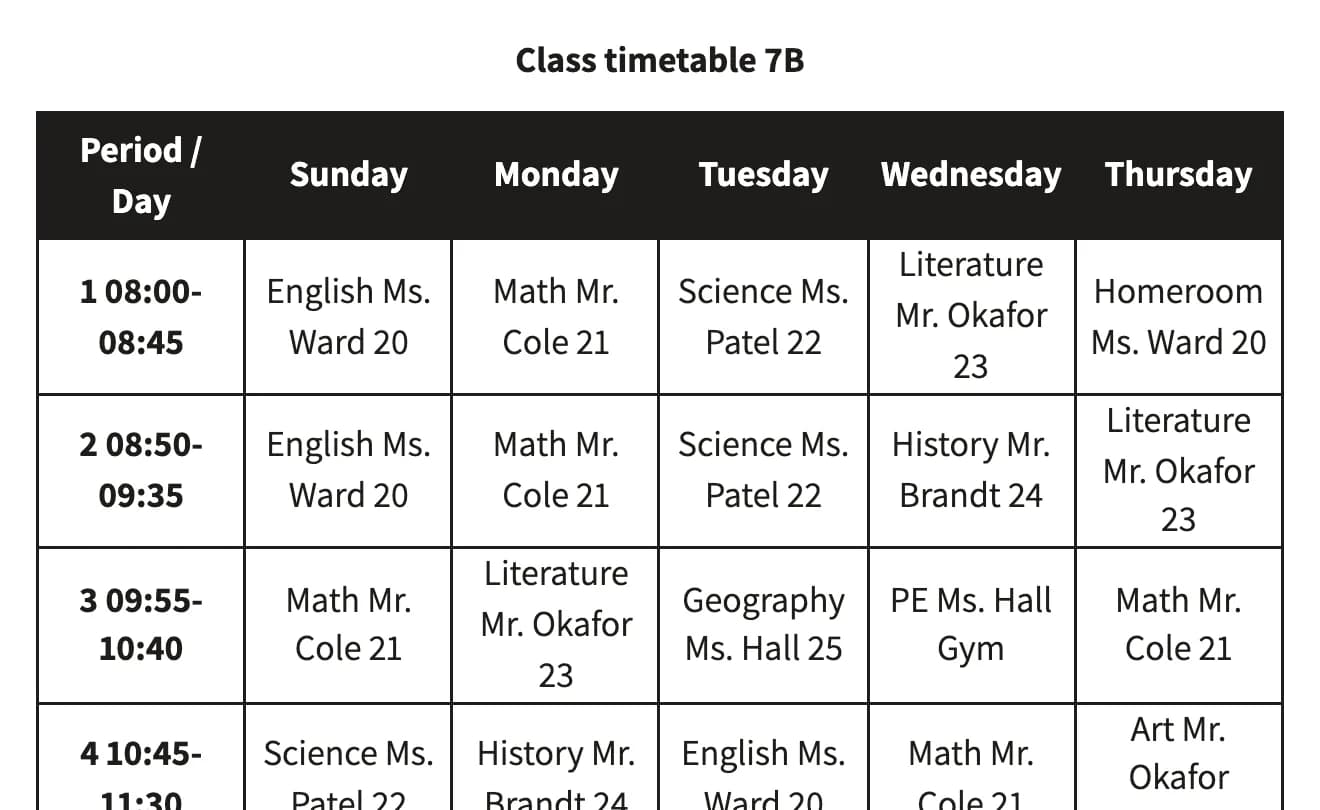
A sample school timetable as a dense black-and-white table: each cell runs the subject, teacher and room number together.
What ClearClass made
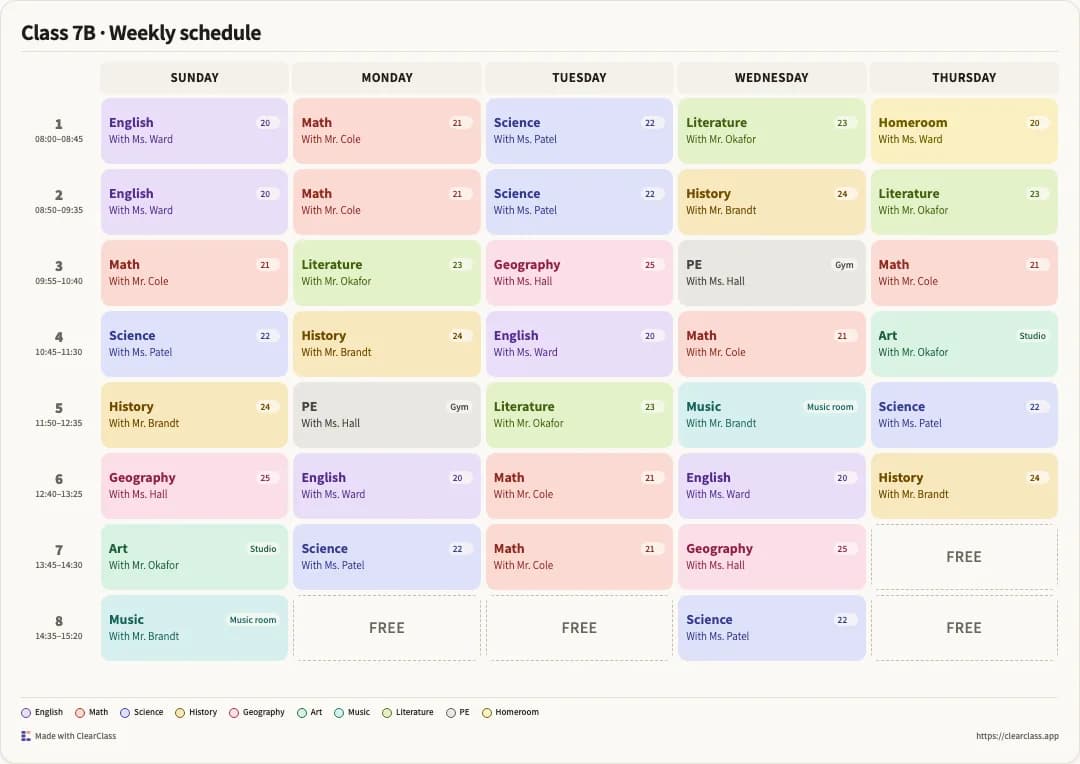
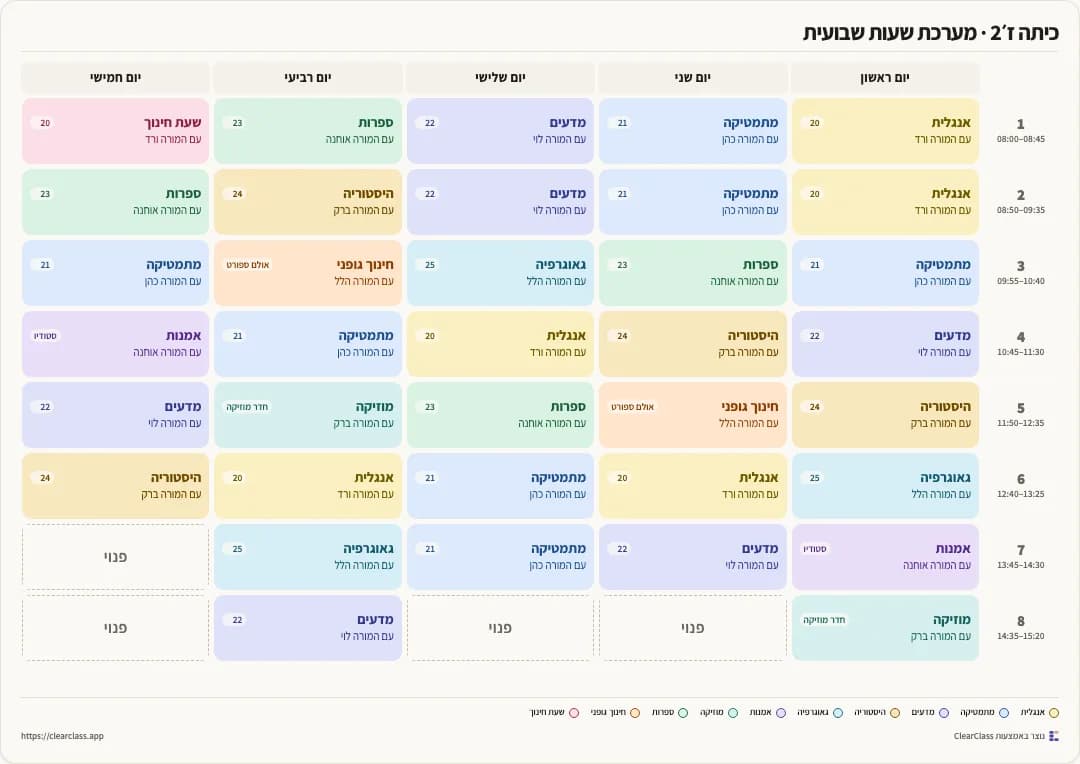
The same week as a ClearClass schedule in the Pastel Cards style: one colored card per lesson with teacher and room, on one page.
ClearClass's own published example: a sample timetable, and the schedule ClearClass produces from it.

01The spark

A request from my daughter

Origin

  1. A timetable from school, hard to read
  2. A one-page version, made with Claude
  3. Shared with the other parents
  4. ClearClass, for every parent

My daughter sent me the timetable she'd received from school and asked me to print it.

The original was almost comically difficult to read.

Tiny text, too much information squeezed into each lesson, and a layout that occupied two pages when one should have been enough.

I took it to Claude and transformed it into a colorful, readable, single-page timetable.

I shared the result with the other parents. For a day, I was something of a hero.

Then I thought: why shouldn't every parent be able to do this?

The concept was simple. Upload whatever timetable the school provided and receive something you can actually use.

I decided to turn it into a publicly available product.

02The product

Make existing information useful

ClearClass doesn't attempt to replace school scheduling systems.

It solves a much narrower problem: making the information those systems already produce useful to students and parents.

Users can upload a PDF, an image or plain text. AI interprets the timetable and transforms it into a structured schedule.

Users can review the result, correct individual details such as lesson names or classrooms, and select from a small set of predefined visual styles.

One visit, no account

  1. 1Upload

    A PDF, an image or plain text, whatever the school sent.

  2. 2Interpret

    AI turns it into a structured schedule.

  3. 3Review and correct

    Fix details such as lesson names or classrooms.

  4. 4Choose a style

    One of a small set of predefined styles.

  5. 5Print and share

    Readable, printable, shareable.

The whole experience, start to finish.

The output is designed to be readable, printable and shareable.

Both Hebrew and English are supported natively.

The same week as a ClearClass schedule in the Pastel Cards style: one colored card per lesson with teacher and room, on one page.Pastel Cards
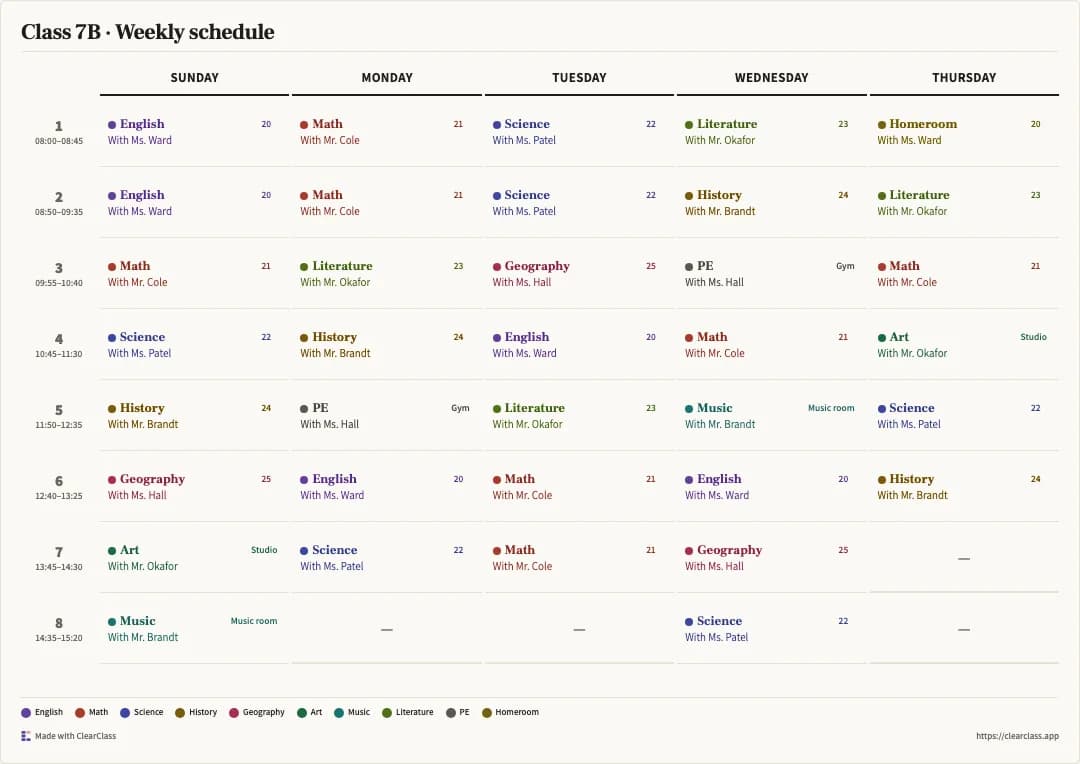
The same schedule in the Ledger style: a clean grid with a colored dot per subject and a subject legend.Ledger
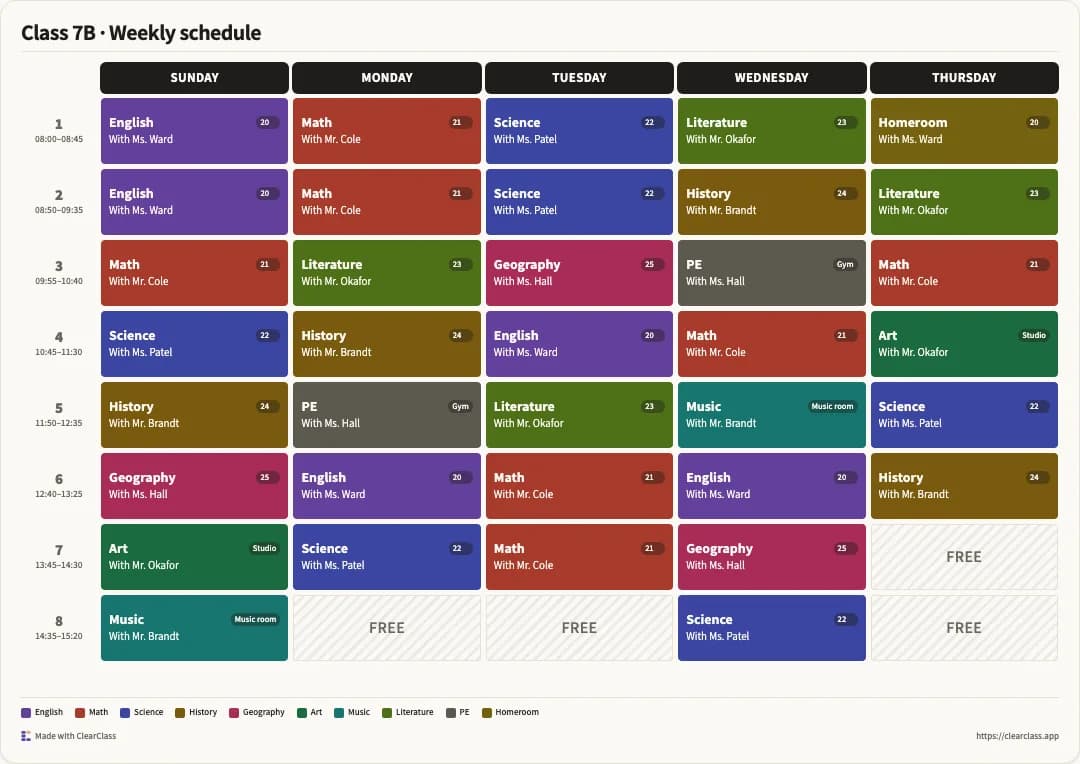
The same schedule in the Color Blocks style: solid colored lesson blocks.Color Blocks
The same kind of schedule in Hebrew, laid out right to left in the Pastel Cards style.Hebrew · RTL
The three predefined styles, from ClearClass's published examples, and the Hebrew version laid out right to left.

There are no user accounts. You arrive, provide a timetable, review the result and use it.

That simplicity is deliberate.

03Decisions

Decisions that mattered

An MVP must be complete enough to test the opportunity

Dilemma
How little can I build and still learn whether this deserves more investment?
The call
Ship the smallest complete experience, including the means to grow, be found, measure and listen.
Trade-off
More than the bare feature set. Styling, grouping, languages and schedule types were postponed.

I originally allocated about a week and a half to this experiment.

My guiding question was the classic product-management question:

What's the minimum I need to build to deliver the promised value and learn whether this opportunity deserves further investment?

I decided that the first release needed to handle common input formats in both supported languages, offer enough editing to correct mistakes, and produce an output people could genuinely use.

I deliberately limited styling options and postponed advanced lesson grouping, additional languages, other schedule types and many other possible enhancements.

But I included capabilities that don't always appear in conventional MVP discussions.

Sharing, because the product needed an opportunity to grow organically.

SEO, because people needed a way to discover it.

Product and web analytics, because I needed to understand whether anyone was actually using it.

And a feedback form, because behavioral data alone couldn't tell me everything users wanted.

Accessibility, privacy and security also had to be addressed before releasing it publicly.

The V1 boundary

Core value

  • Common input formats
  • Hebrew and English
  • Enough editing to correct mistakes
  • Output people can genuinely use

To learn and grow

  • Sharing to grow organically
  • SEO to be discovered
  • Analytics to know if it's used
  • Feedback form for what data can't say

Before going public

  • Accessibility
  • Privacy
  • Security

Deliberately postponed

  • More styling options
  • Advanced lesson grouping
  • Additional languages
  • Other schedule types
Grouped from the decisions above.

A minimum viable product isn't simply the smallest amount of functionality you can code.

It's the smallest complete experience that delivers value and gives you meaningful evidence about the opportunity.
Real inputs matter more than perfect examples

Dilemma
It worked on prepared examples, then failed on a timetable forwarded through WhatsApp.
The call
Add image rotation and upscaling.
Trade-off
Not ambitious features, but the core promise depended on them.

During development, a friend forwarded me an actual school timetable he'd received through WhatsApp.

The system failed to process it properly.

That example led me to introduce image rotation and upscaling.

These weren't ambitious features. They were necessary to make the core promise work with the kind of imperfect material real users would provide.

It's a small example of a fundamental product principle: an implementation that succeeds on carefully prepared examples hasn't necessarily solved the user's problem.

Invest in reusable foundations, not just a disposable application

Dilemma
Build only what ClearClass needs, or separate what other products could reuse?
The call
Separate reusable infrastructure from ClearClass-specific logic.
Trade-off
Added development time. The analytics foundation already serves CraftAWorld.

The project eventually took a little more than a month, rather than the week and a half I'd initially planned.

Plan versus reality

  • PlannedAbout a week and a half

  • ActualA little more than a month

Bar lengths are approximate, from the durations in the text.

Part of the reason was the considerable difference between a functioning concept and a public product.

Deployment, analytics, accessibility, privacy, security, SEO, multilingual UX, error handling and non-happy-path flows all required attention.

I also deliberately separated reusable infrastructure from ClearClass-specific application logic.

That added development time, but created components I could reuse across other products.

The product analytics foundation developed for ClearClass has already been adopted by CraftAWorld.

So the additional investment served a purpose beyond this single experiment.

04Under the hood

Reliability, privacy and the less glamorous work

The central AI challenge is interpreting documents that don't follow a standard format.

Different schools organize timetables differently. Inputs may be photographs, PDFs or copied text, with variations in layout, abbreviations, orientation and visual quality.

The system must extract the schedule into a structured representation without losing important information.

Users can correct smaller interpretation errors before printing or sharing.

Privacy was another important consideration.

School timetables may include information about children and teachers. ClearClass therefore provides contextual warnings before sharing, as well as information in its privacy policy.

Shared links use generic previews rather than exposing timetable contents in messaging-app previews.

Regular timetables are automatically deleted after 24 hours. Sharing extends the retention period by three days, and users can also request earlier deletion.

How long a timetable lives

Regular timetableDeleted after 24 hours

  1. 24 hours
  2. deleted

Shared timetableRetention extended by three days

  1. 24 hours
  2. + three days
  • Earlier deletion on request
  • Contextual warning before sharing
  • Generic link previews
  • Explained in the privacy policy
Schematic timeline. Shared links reduce exposure but are not access-controlled documents.

These measures reduce exposure, but they don't make shared links private access-controlled documents. The user still needs to understand what they're choosing to share.

All of this sits outside the original AI transformation concept.

It's also the work that distinguishes a functional demonstration from a public product.

What a demo showsThe AI transformation

Functional demonstration · public product

What a public product also needs
  • Deployment
  • Analytics
  • Accessibility
  • Privacy
  • Security
  • SEO
  • Multilingual UX
  • Error handling
  • Non-happy-path flows
The list is the one from the third decision above.

05Building with AI

Speed is easy. Scope control is harder.

AI coding agents handled the implementation while I directed the product, defined the requirements and evaluated the results.

I collaborated with the agents on architecture, testing and quality assurance.

Who did what

MeJudgment

  • Product direction
  • Requirements
  • Evaluating the results
  • Deciding what not to build

SharedTogether

  • Architecture
  • Testing
  • Quality assurance

AI agentsExecution

  • Implementation
  • Proposing roadmap additions

But the project also exposed a weakness in my development process.

As work progressed, agents kept identifying additional things worth adding to the roadmap.

Many sounded reasonable. Not all were necessary for the MVP.

The result was a gradually expanding scope.

Illustration: a dashed MVP boundary around the first release, surrounded by many reasonable additions proposed while building. MVP boundary: Common inputs, Hebrew and English, Editing, Usable output, Sharing, SEO, Analytics, Feedback.

Illustration of the pattern, not a record of specific suggestions.

I learned that AI agents can be exceptionally productive at generating work. It's the product leader's responsibility to decide which work should not be done.

06Status

A low-cost market experiment

ClearClass launched in October 2026.

My objective wasn't to build a large business immediately. It was to release a real product, learn from its usage and see whether the market demonstrated meaningful demand.

What's live, and what waited

  • Public product, Hebrew and EnglishLiveLaunched October 2026
  • PDF, image and text input, with rotation and upscalingShipped
  • Review, correction and three predefined stylesShipped
  • Printing and sharing, with privacy safeguardsShipped24-hour deletion, extended when shared
  • Analytics, SEO and a feedback formShipped
  • Advanced lesson grouping, more languages, other schedule typesPostponedOutside the V1 boundary

I've deliberately kept operating costs very low by sharing infrastructure across my projects and keeping AI inference expenses tied to actual usage.

The first signal I'm watching for is steady, sustained daily traffic, even at a modest level.

The more meaningful milestone is a substantial volume of timetable creations and sharing events, together with how quickly that volume builds once steady traffic is established.

Decision gate

  1. SignalSteady daily traffic

    Sustained, even at a modest level.

    To validate
  2. MilestoneReal volume

    A substantial number of creations and shares, and how fast it builds.

    To validate
  3. ThenReassess investment

    Decide whether it deserves more development.

What has to be true before ClearClass gets more investment.

At that point, I'll reassess whether ClearClass deserves more development investment.

Until then, it can continue operating without demanding significant attention.

It has already produced value through reusable infrastructure and as a concrete demonstration of my ability to ship a complete product.

07Reflections

A tighter roadmap would have helped

Would I build ClearClass again?

Yes.

But I'd enforce a much more aggressive roadmap to MVP.

I would define the launch boundary earlier, make the definition of done explicit and resist adding features simply because an agent identified another potentially useful improvement.

I don't regret the investment in reusable infrastructure. It has already benefited other projects.

And I don't regret spending the extra time on the work required to turn a demo into something people can actually use.

But ClearClass also clarified my investment priorities.

I no longer need to build another small, attractive AI product simply to demonstrate that I can.

I've checked that box.

Future projects need a clearer path to meaningful revenue.

Keep exploring

I work with leadership teams on AI transformation, product and data strategy, and building the capabilities to deliver it. Let's talk

Next case study

CraftAWorld

The flagship, and the first reuse of ClearClass's analytics foundation.